

How to Play Hold and Win Slots: A Control-Bar Guide
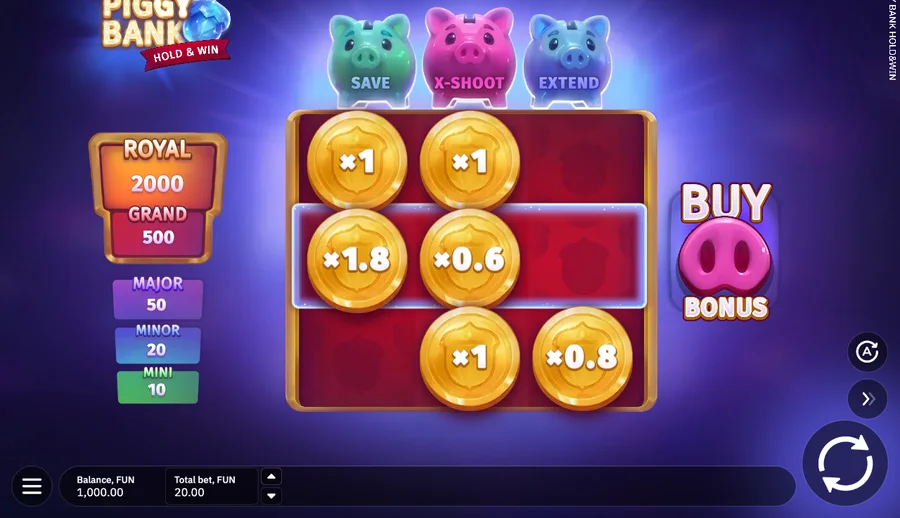
In short: In a Hold and Win slot every symbol that lands sticks in place for a run of respins, and the round pays the whole grid at the end. This one takes that further: its base reels pay nothing at all, so every payout arrives inside a respin round. In Piggy Bank Hold&Win that round opens on three coins in the middle row.
You set one number on this game, and the client offers eighteen of them, from 0.10 up to 100.00. The rest of the control bar leaves the cost of a spin alone.
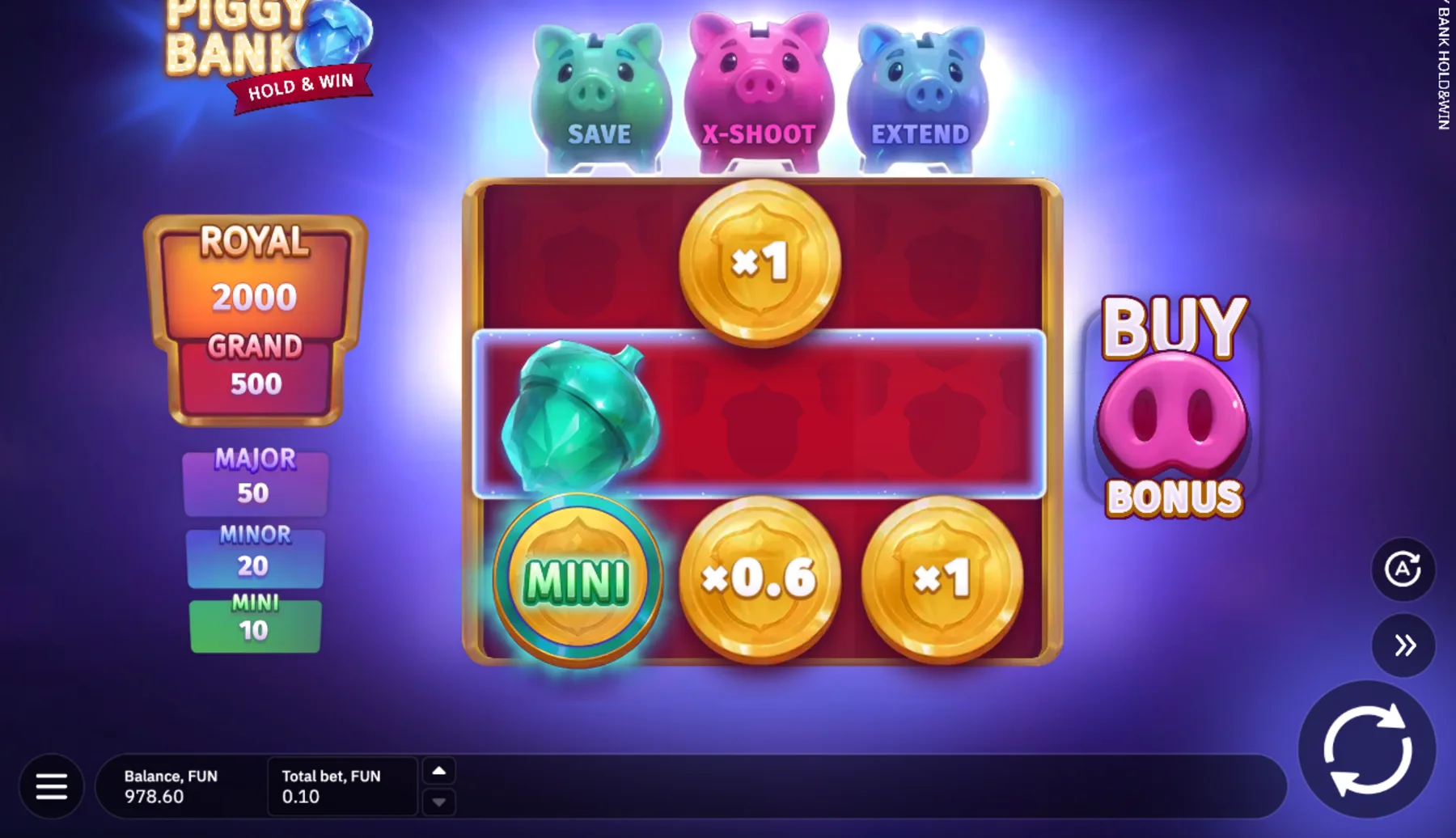
- Game:
- Piggy Bank Hold&Win (a BGaming video slot)
- Type:
- Slot game
- RTP as published:
- 96.98% for an ordinary spin, and the maker prints that figure in three places that agree: the game page, the client's rules screen and the game server's own settings response.
- Max win:
- 2,500 times the bet, two lines below a top jackpot the same screen puts at 2,000.
Note: You set one number in Piggy Bank Hold&Win, then pick from eighteen of them. Everything else on the bar changes speed, sound, or how many rounds run while you watch. We counted the whole stepper by hand in BGaming's free demo on . The launch configuration the client receives agreed with us: 0.10 at the floor, 100.00 at the ceiling.
Table of contents
- What You Need Before You Start
- How a Round Plays, Step by Step
- Set Your Hold and Win Stake First
- Read the Panel Before You Play
- Play the Round, Watch the Counter
- Set Autospins Only After a Limit
- The Stepper Runs 0.10 to 100.00
- Autospins Stop on Five Triggers
- Five Ways to Stop an Autospin Run
- How 122 Paid Spins Actually Played
- What the Control Bar Hides
- Key Terms Used on This Page
- What Else Do Readers Ask
What You Need Before You Start
Before you start, check these prerequisites; each one takes a minute and saves a wasted round.

- No account: the demo opens the game straight from BGaming's own page, with no login or email.
- No money: the client loads a play balance of 1,000.00 FUN, then charges zero for a spin.
- An age check: BGaming shows its 18+ window only when you follow a link off its own site, so the confirmation on this page is ours.
- Ten quiet minutes: reading the rules screen end to end takes longer than your first bonus round will.
How a Round Plays, Step by Step
Follow these steps in order; the index below jumps to any step, and each step names the control it uses.
- Step 1: Set the stake before anything else
- Step 2: Walk the stepper down
- Step 3: Count the stops on the way up
- Step 4: Read the panel first
- Step 5: Check the jackpot ladder
- Step 6: Change the bet, then look again
- Step 7: Play the round and watch the counter
- Step 8: Press spin and wait
- Step 9: Count three coins on the middle row
- Step 10: Read the piggies above the grid
- Step 11: Let the round finish before clicking
- Step 12: Set the limit first, then the run
- Step 13: Open the autospin menu
- Step 14: Tick a stop condition
Set Your Hold and Win Stake First
Step 1: Set the Stake Before Anything Else
The total bet is the only control on this bar that changes what a spin costs, and the client opens at 2.00 on a play balance of 1,000.00 FUN. Everything else alters speed, sound, or how many rounds run unattended.
Step 2: Walk the Stepper Down
Hold the minus arrow under Total Bet until it stops moving. It settles at 0.10, a floor the client keeps off screen.
Step 3: Count the Stops on the Way Up
0.10, 0.20, 0.30, 0.50, 0.70, 1.00, 1.50, 2.00, 2.50, 3.00, 5.00, 10.00, 15.00, 20.00, 30.00, 50.00, 70.00, 100.00. That makes eighteen.
Read the Panel Before You Play

Step 4: Read the Panel First
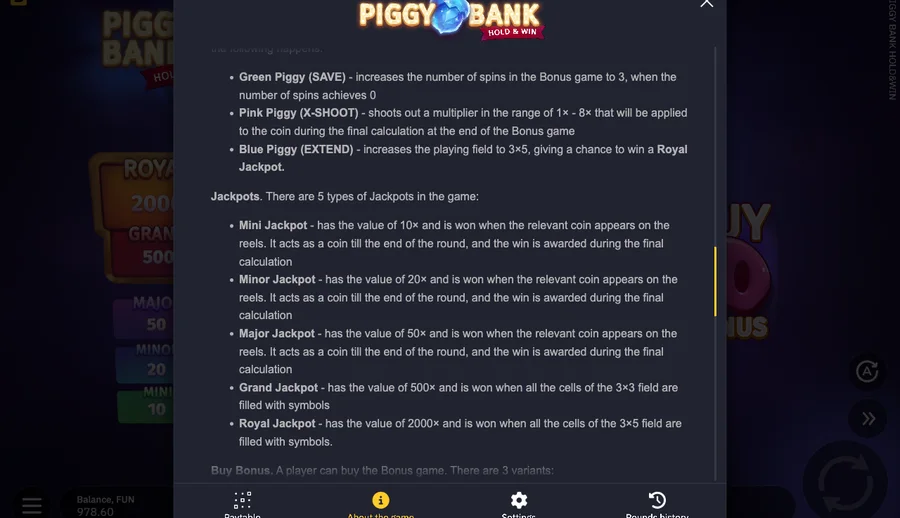
Two of its figures are not what they look like, and one of them is the return. Open the menu at the lower left, choose About the game, then scroll to the end: 96.98% sits there beside the version stamp for your build.
Step 5: Check the Jackpot Ladder
The strip down the left prints Royal 2000, Grand 500, Major 50, Minor 20, Mini 10. Those are multiples of your stake rather than cash amounts.
Step 6: Change the Bet, Then Look Again
Move the stepper from 0.10 to 20.00. Read the ladder a second time. We did, and all five figures held still, which proves what they measure.
Play the Round, Watch the Counter
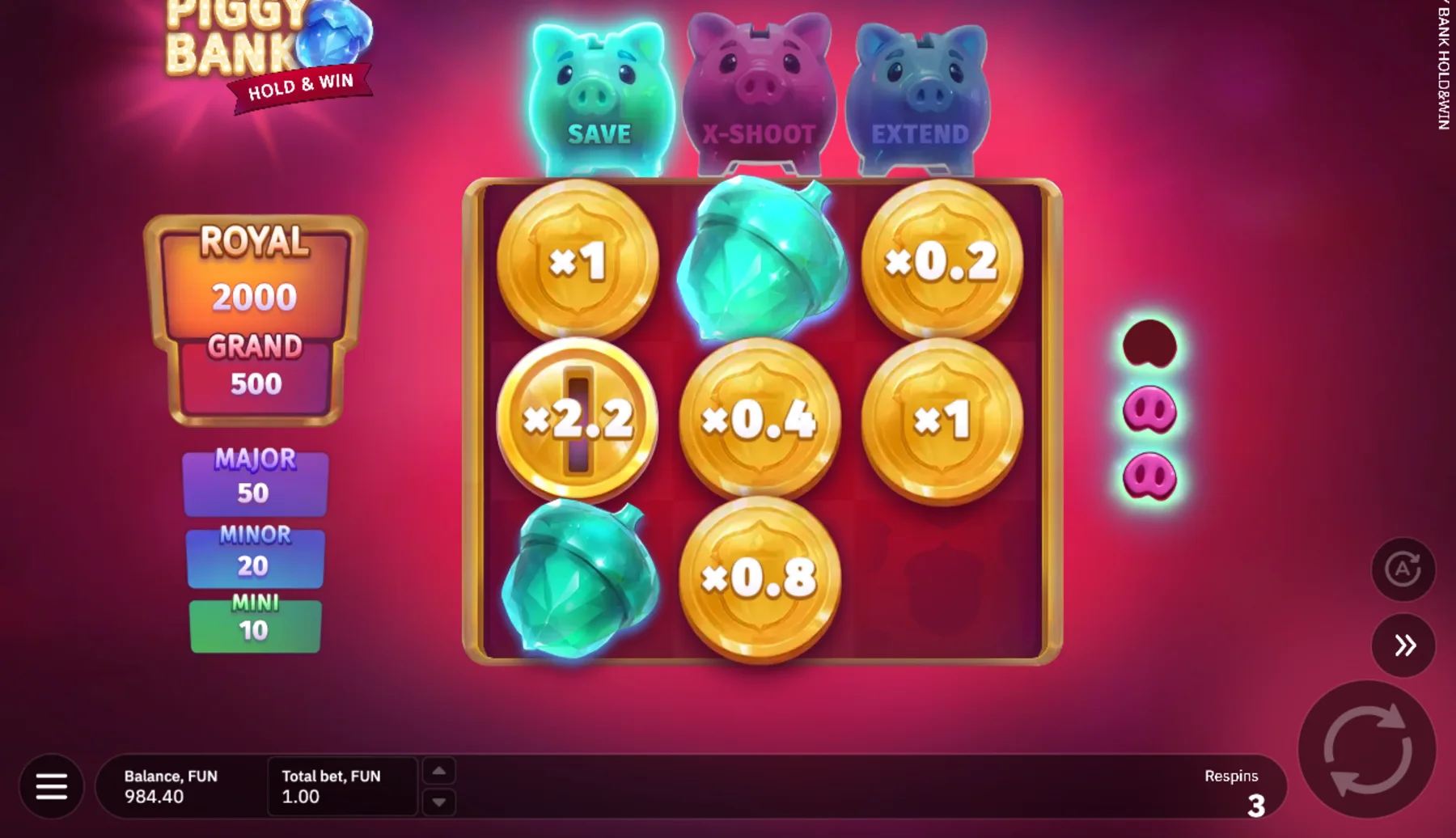
Step 7: Play the Round and Watch the Counter
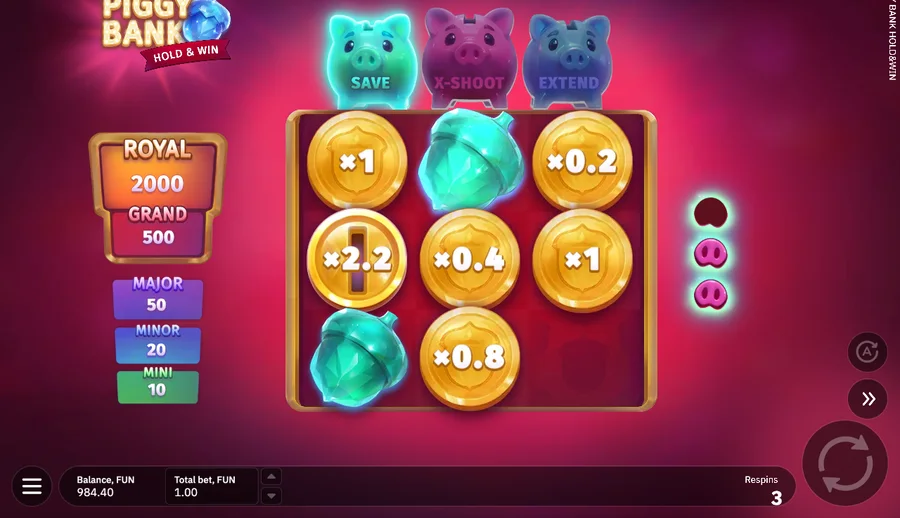
That number decides how long a round lives, and nothing else on screen does. It opens at three, resets to three whenever a fresh symbol lands, and drops by one on an empty spin.
Step 8: Press Spin and Wait
Every payout here comes from the bonus round. Across 122 paid spins at a 1.00 stake, the base grid gave us back zero.
Step 9: Count Three Coins on the Middle Row
Three coin symbols landing on the central horizontal row open the Hold & Win round. The background turns red, with a Respins counter at the lower right.
Step 10: Read the Piggies Above the Grid
Green SAVE refills the counter at zero. Pink X-SHOOT fires a 1x to 8x multiplier at a coin. Blue EXTEND stretches the grid to 3x5. All three switch on at random.
Step 11: Let the Round Finish Before Clicking
The spin button goes dead while a bonus runs, so extra clicks land nowhere. We threw away 27 of 45 clicks that way before spotting it.
Set Autospins Only After a Limit
Step 12: Set the Limit First, Then the Run
An unattended run needs a stop you chose while calm, because the menu will happily turn a thousand rounds without one. Pick the balance-decrease condition before you pick a round count.
Step 13: Open the Autospin Menu
The client offers runs of 10, 25, 50, 100, 250, 500, 750 or 1000 rounds, plus an endless one. Pick a count you can afford to lose at the stake from step one.
Step 14: Tick a Stop Condition
Five sit in the menu. The useful pair is a balance floor plus a balance ceiling. Leave both blank, and a run ends only when the round count does.
The Stepper Runs 0.10 to 100.00
The stepper runs from 0.10 at the floor to 100.00 at the ceiling, eighteen stops in all. The range those stops span is kept off the client's own screen.
BGaming's rules template promises to name the minimum bet alongside the maximum. The running client prints neither line. A licence setting in the build we loaded switches it off, so you can work the stepper for a minute while still guessing where it ends.
One caveat travels with that ladder. We counted it in the demo build, the one BGaming serves from its own page, and the same rules warn that a licence can switch off the purchases, Auto Mode and Quick spins. What a Canadian build prints for these eighteen figures we have not seen.
| Band | Stops the client offers | Gap between stops |
|---|---|---|
| Under 0.50 | 0.10, 0.20, 0.30 | 0.10 each time |
| 0.50 to 1.00 | 0.50, 0.70, 1.00 | 0.20, then 0.30 |
| 1.50 to 3.00 | 1.50, 2.00, 2.50, 3.00 | 0.50 flat |
| 5.00 to 20.00 | 5.00, 10.00, 15.00, 20.00 | 5.00 flat |
| 30.00 to 100.00 | 30.00, 50.00, 70.00, 100.00 | 20.00, then 30.00 |
Read on ; the maker can change a screen without saying so.
Autospins Stop on Five Triggers
Autospins stop on five triggers, and the rules name each of the five in plain words. Two of them matter enough that we set them before any unattended run.
Two earn their place every time. A balance floor ends a run once you are down by an amount you picked while calm. A ceiling does the same job on the way up.
Leave both empty, and the run lasts until the round counter empties.
Five Ways to Stop an Autospin Run
| Stop condition | What the rules say it does | Why it matters here |
|---|---|---|
| On any win | Stops when you win | On this game that means a bonus round, the only thing that pays |
| If bonus game is won | Stops when a bonus triggers | The trigger worth watching; ours fired seven times |
| If single win exceeds | Stops above a set amount | Handy at a high stake, where one round paid us 31.2x |
| If cash balance increases by | Stops on a set gain | The ceiling, easy to forget |
| If cash balance decreases by | Stops on a set loss | The floor, the one we always set first |
We do not recommend running autospins on this game with both balance stops left blank. The base grid pays nothing, so a run of 100 rounds at 1.00 can spend 100.00 with no interruption at all, and ours averaged about 17 paid spins between its seven bonus rounds.
How 122 Paid Spins Actually Played
122 paid spins played as a long flat stretch broken by seven short payouts, and the closing balance was 21.40 down.
One session stands behind every first-hand figure on this page, played on fun money at a stake fixed at 1.00 across 122 spins we paid for and 65 respins.
| Measurement | Figure | What it means |
|---|---|---|
| Paid spins at a 1.00 stake | 122 | Every one of them came back empty on the base grid |
| Respins inside bonus rounds | 65 | Free of charge, played at the triggering stake |
| Bonus rounds reached | 7 | One every 17.4 paid spins on this run |
| Best single round | 31.20 | 31.2x the stake, on a 1.00 bet |
| Closing balance | 978.60 | Down 21.40 from 1,000.00, a session return of 82.5% |
That 82.5% describes one evening, then stops there. BGaming models 96.98% across a volume far beyond an evening's play, so 122 spins is noise beside it.
We print the run because it shows the rhythm: long flat stretches, then a sudden payout.
What the Control Bar Hides
Three numbers live in this build, and all of them stay off the screen.
The game server hands the client the odds of the 2,500x ceiling, 1 in 44,731,998. It passes over the bet floor plus the bet ceiling as well, and although the rules template keeps a slot for each of those lines, the licence settings in the build we loaded leave all of them dark on the way to the screen. Counting the stepper by hand becomes the only route to its limits.
Whether another screen somewhere carries those two lines sits beyond what a demo can answer, so we record what this build does and leave the rest open.
- Set the floor first: Choose the balance-decrease stop before the round count, because that is the one setting which ends a run you are losing.
- Work the stepper once: Twenty seconds gives you the 0.10 floor plus the 100.00 ceiling that the demo build keeps dark.
- Watch the counter, not the coins: Any fresh symbol resets the Respins counter to three, so a crowded grid buys more spins than a valuable one does.
- Don't click through a bonus: The spin button is dead while the round runs, and we lost 27 clicks before spotting that.
- Treat our 82.5% as noise: One short session ran well under the published 96.98%, and 122 spins cannot measure a game.
- If none of that fits how you play: Stay in the demo. It costs zero, and a bad hour there is free.
Key Terms Used on This Page
- Respin
- A spin inside the Hold & Win round that costs nothing extra; the counter opens at 3 and resets to 3 on any new symbol.
- Total Bet
- The only stake control in Piggy Bank Hold&Win, stepping through 18 stops from 0.10 to 100.00.
- Hold & Win round
- The one part of the game that pays, opened by 3 coin symbols landing on the central row.
- Sticky Coin
- A coin worth 5x to 9x the stake that lands in the base game and carries into a bonus round, though not into a bought one.
- Mystery symbol
- The green acorn, which resolves at the end of a round into any symbol except a Sticky Coin.
- Autospins
- An unattended run of 10 to 1000 rounds, or an endless one, with 5 stop conditions in the menu.
Not sure yet? Try the free demo first and learn the round with play money before any deposit.
Try the free demo first →This site takes no deposits and runs no identity checks; both stay off it entirely.
Related Reading on This Game
More on this game, from the same section first:
 Guides
Free demo client
1,000.00 play-money balance, 18 stake steps
 Guides
Provable Fairness Checks
3 fairness titles named, not this one
 Guides
Bonus Buy Prices
30x, 60x, 200x; returns 96.98-97.02%
 Reviews
Full Review and Score
96.98% RTP, nothing pays outside bonus
 Reference
RTP and the Hidden Lines
96.98% base, 97.02% on Piggy Trio
 Reference
Jackpot Values Compared
Royal 2000x, advertised as 2500x
 Reference
Hold and Win Explained
291 of 631 coins under 1x the bet
 Reference
Six Namesakes Compared
96.98% vs 96.10% vs 96.04%
What Else Do Readers Ask?
Most questions about this game's controls come down to two figures the client never prints: where the stepper starts and where it stops. The answers below come from the stepper itself, and from the launch configuration the client receives.
Do you need an account to play a Hold and Win slot for free?
No, BGaming's own demo opens the game without a login, a deposit or an email, on a play balance of 1,000.00 FUN.
What is the lowest bet in Piggy Bank Hold&Win?
The stepper stops at 0.10, and the client never prints that figure anywhere; we found the floor by holding the minus arrow until it stopped moving.
How many bet steps does the stepper offer?
Eighteen stops run from 0.10 to 100.00, counted by hand and confirmed against the settings the game server sends the client at launch.
Does the base game ever pay?
No, nothing on the reels pays outside the Hold & Win round, and across 122 paid spins we never once won on the base grid.
What starts the bonus round?
Three coin symbols landing on the central horizontal row open it, and the rules name no other trigger for the Hold & Win round.
How long does a Hold & Win round last?
The counter opens at three respins and resets on any new symbol; our seven rounds ran between 3 and 16 respins.
Can autospins be stopped automatically?
Yes, the menu carries five stop conditions, including a balance floor and a balance ceiling, and the rules describe each one in plain words.
How do we test a slot's control bar?
We walk every stepper stop by hand in the maker's free demo, then check the readings against the settings its game server sends.
Is there a way to make the game pay more often?
No, a certified random number generator deals the round that pays, so no stake pattern or autospin setting changes how often it arrives.
Does the jackpot panel show cash or multipliers?
Multipliers. We moved the stake from 0.10 to 20.00, and the five figures, Royal 2000 down to Mini 10, did not move at all.