Table of contents
Return to Player (RTP)
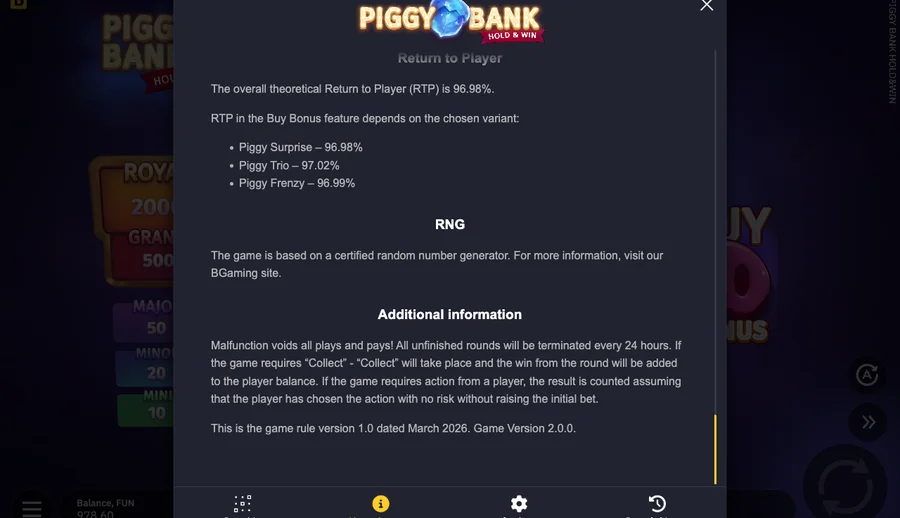
Return to player is the share of all stakes a game is modelled to pay back over a long run. On Piggy Bank Hold&Win that figure is 96.98%. BGaming states it three times: on its game page, on the client's rules screen, and in the settings its game server sends when the game loads.
- Game:
- Piggy Bank Hold&Win (a BGaming video slot)
- Type:
- Slot game
- RTP as published:
- 96.98% for an ordinary spin, and the maker prints that figure in three places that agree: the game page, the client's rules screen and the game server's own settings response.
- Max win:
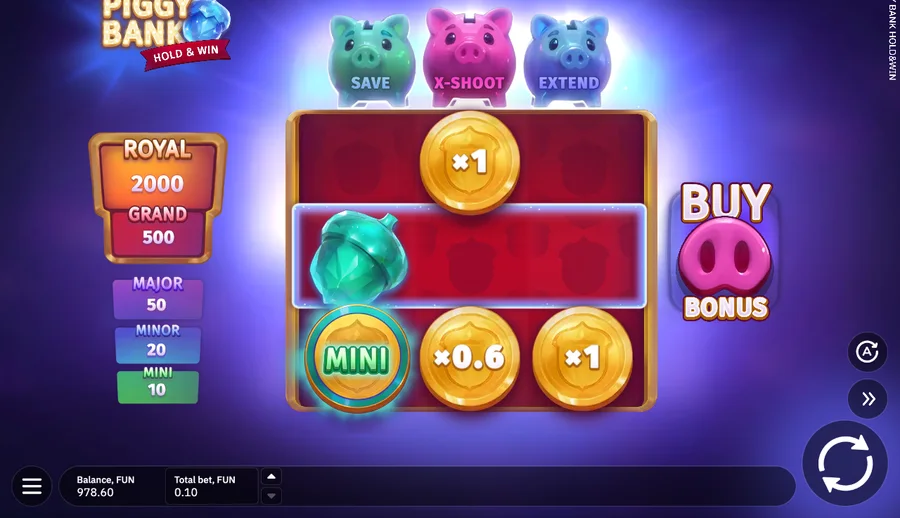
- 2,500 times the bet, two lines below a top jackpot the same screen puts at 2,000.
Where the Piggy Bank RTP Comes From
The 96.98% comes from BGaming, which states it three times with all three readings in agreement. The Details block on the game page prints "RTP 96.98 %". The rules screen inside the client prints a full sentence: "The overall theoretical Return to Player (RTP) is 96.98%." When the client loads, the game server hands it a settings response carrying the same figure.
Three surfaces, one number.
That sounds unremarkable until you have met a slot whose maker publishes a spread, leaving the pick to somebody else. Here a single figure stands to be argued with. Checking it costs nothing: open the free demo, tap the menu at bottom left, choose About the game, then scroll to the heading that reads Return to Player. Ninety seconds in a browser, open to anyone. The same screen carries the rule version, 1.0 dated March 2026, which matches the release date the game page prints.
One caveat travels with all three readings, though. It is the ordinary one. A theoretical return describes a modelled long run; a single afternoon sits somewhere in a wide spread around it.
What a Buy Does to the RTP
Buying a round moves the return. The client states a separate percentage for each of the three doors, on its About the game screen rather than on the buy cards themselves. Piggy Surprise returns 96.98%, which is the base game exactly. Piggy Trio returns 97.02%. Piggy Frenzy returns 96.99%.

| Where it applies | Return printed | What the house keeps | What it costs |
|---|---|---|---|
| Base game | 96.98% | 3.02% of every stake | one stake per spin |
| Piggy Surprise | 96.98% | 3.02% of every stake | 30x the bet |
| Piggy Trio | 97.02% | 2.98% of every stake | 60x the bet |
| Piggy Frenzy | 96.99% | 3.01% of every stake | 200x the bet |
Read on ; the maker can change a screen without saying so.
What the Piggy Trio Buy Actually Buys
Piggy Trio returns more than the base game, by four hundredths of a percentage point. Piggy Surprise matches the base game to the hundredth, and Piggy Frenzy adds a single hundredth for more than three times the price. The size is the part that bites. On a 60-stake purchase, four hundredths of a point comes to 0.024 of a stake.
Call it a rounding error with a price tag.
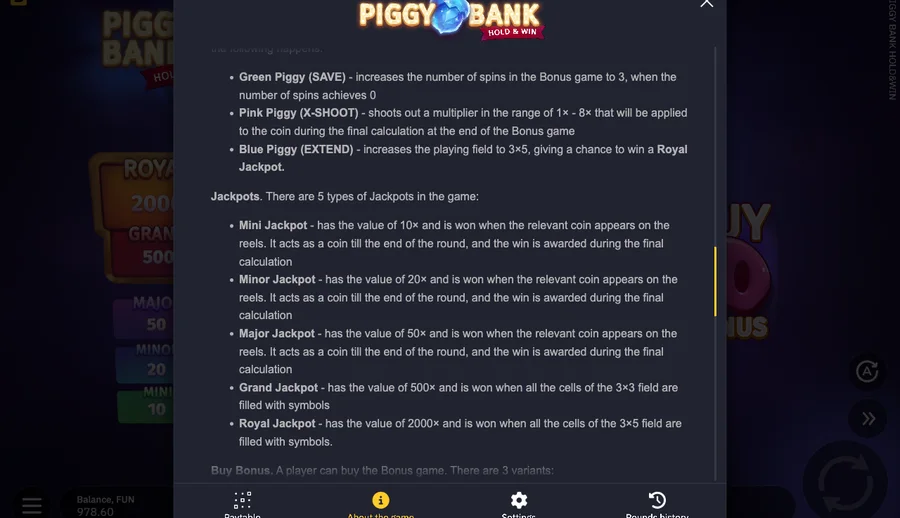
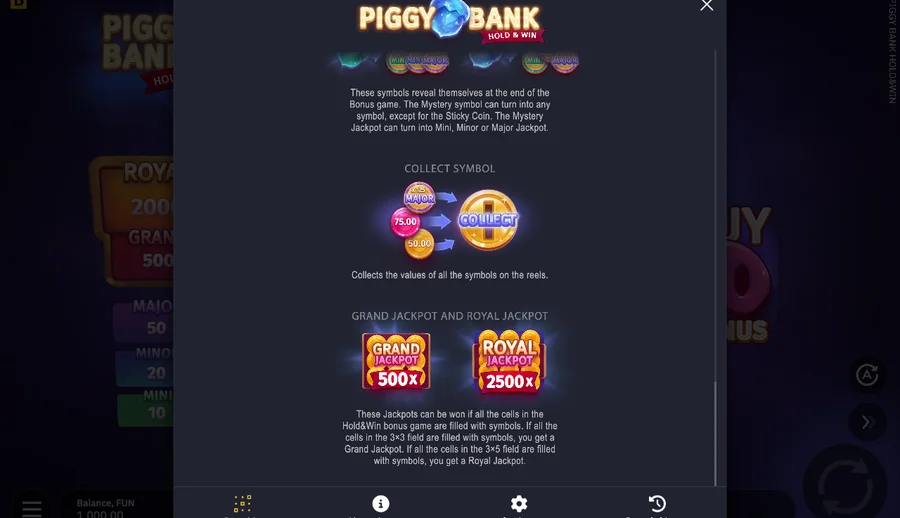
We do not recommend BGaming's own game page as your source for the jackpot ladder. It gets 96.98% right. Four of its five jackpot tiers disagree with the running client, Royal by 500 times the bet: its Features block prints 2,500x where the rules screen, the panel and the game server all say 2000x.
If you want the cheapest published entry to the bonus round, Piggy Surprise at 30 stakes is the floor. If you want all three piggies guaranteed, two doors promise it and Piggy Trio at 60 is the cheaper one; Piggy Frenzy guarantees the same three for 200 and adds a multiplier on every spin. If neither appeals, the base game runs at that same 96.98% for the price of one stake. That is where our whole 122-spin run stayed: we opened the purchase menu to read the prices and bought nothing.
The Lines the Client Never Prints
Two lines of the rules template never reach the screen, and the server has already worked out the number for each of them. The rules document BGaming serves is a template with gaps in it. Two of those gaps matter here. One reads "The probability of winning the max win {max_multiplier}x in the game is 1:{max_win_freq}". The other reads "The minimum bet value is {min_bet}. The maximum bet value is {max_bet}".
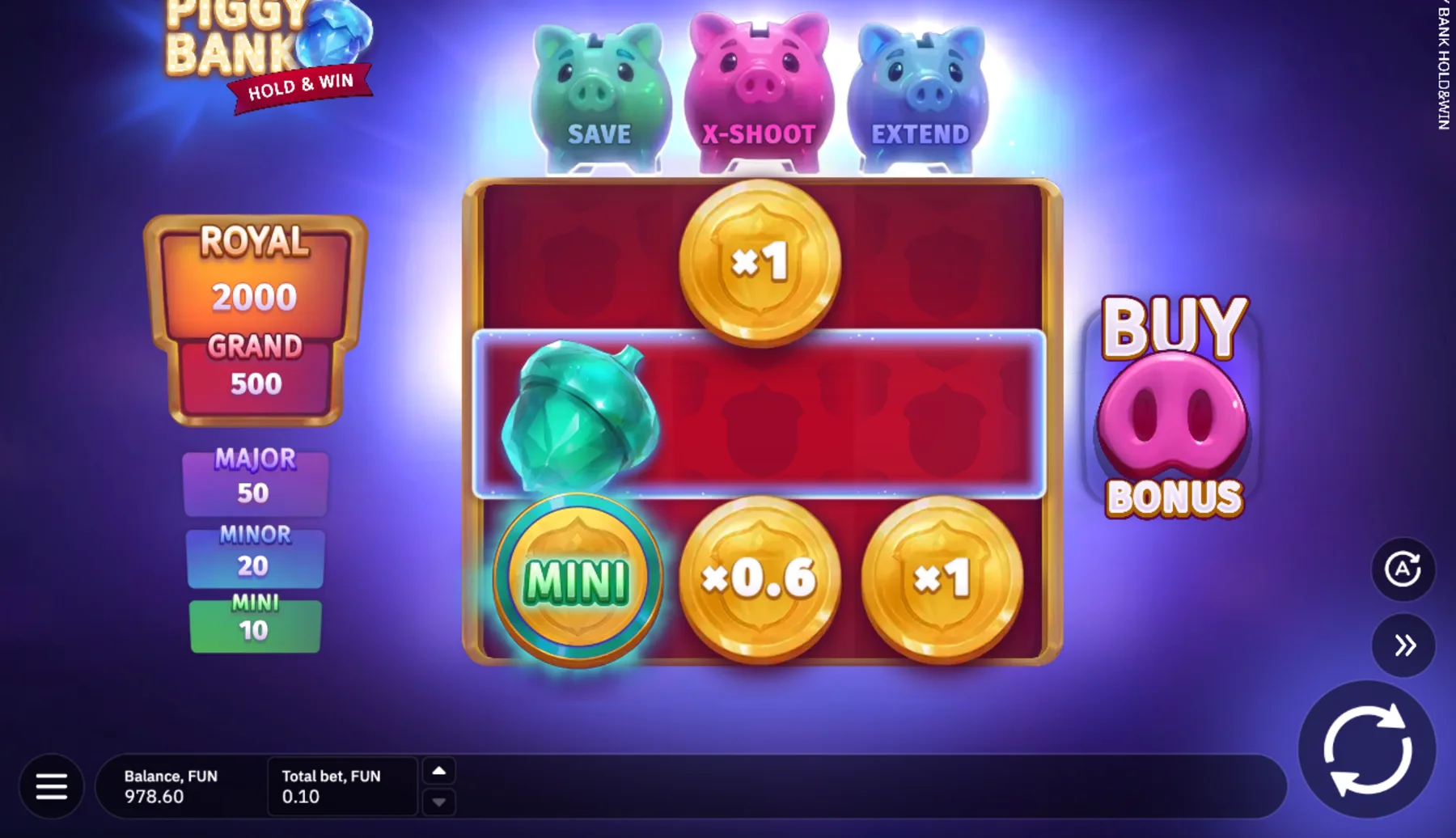
The server fills both. We pulled the launch configuration the client receives at load, then read the values straight out of it. The odds of the 2,500x ceiling sit at 1 in 44,731,998. The bet range runs from 0.10 to 100.00 across eighteen steps.
Both lines stay off the screen, because the same configuration carries the switches that decide. One of them, show_max_win_frequency, is set to false. The other, show_min_max, is set to false as well.
| Figure | What the server supplied | What the player saw |
|---|---|---|
| Overall return | 96.98% | printed in full |
| Maximum win | 2,500x the bet | printed, two lines under a top jackpot of 2000x |
| Odds of that maximum win | 1 in 44,731,998 | blank |
| Minimum and maximum bet | 0.10 to 100.00 | blank |
| Return on the main lobby screen | 96.98% | switched off by its own flag |
So the set of figures a player gets to read is a setting rather than a property of the game. The game server corroborates the rules screen on the return. The launch configuration sitting beside it challenges the idea that the rules screen is complete, since two of the template's own lines render as blanks.
Our 122 Spins Returned 82.5%
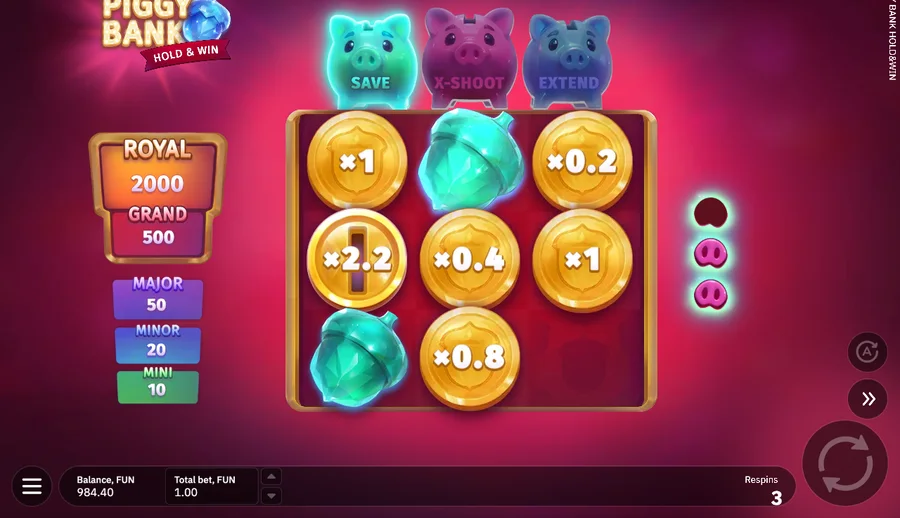
Our own run returned 82.5%, which describes the run alone. We played BGaming's free demo on 13-, held the bet at 1.00 throughout, pressed spin 122 times, logging every round the server sent back. Staked 122.00. Returned 100.60. Closed 21.40 down.
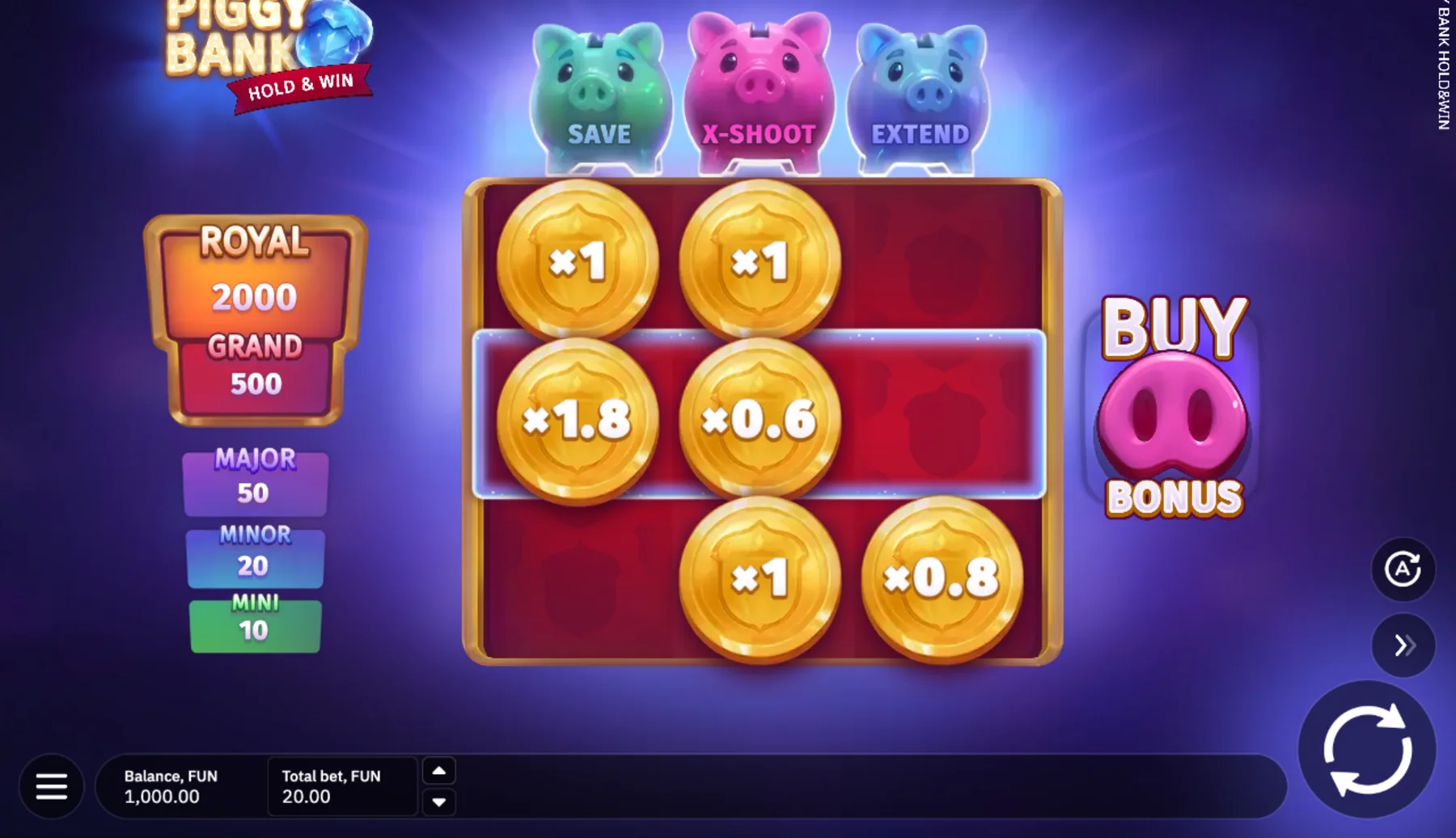
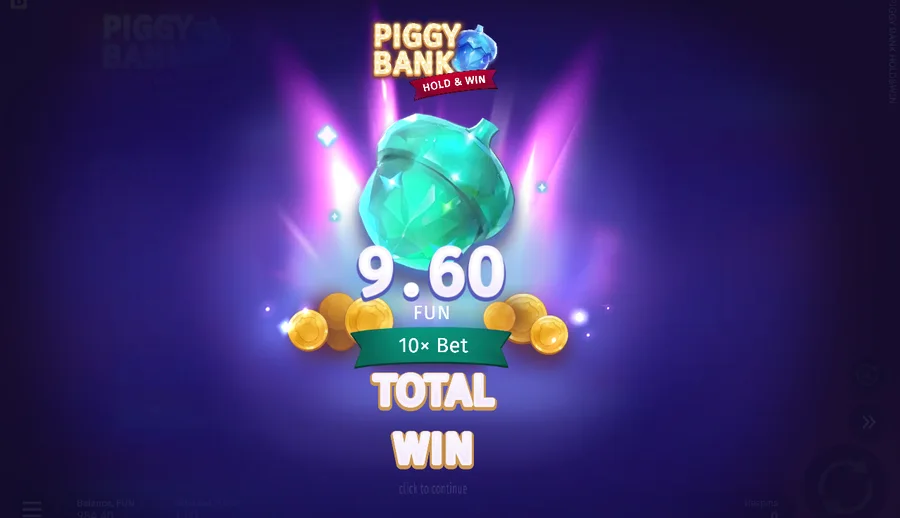
Seven bonus rounds turned up across those 122 spins. All seven payouts arrived inside a bonus round, which is the game behaving exactly as its rules describe: these reels pay only there. The best of the seven paid 31.20, or 31.2 times the bet.
What 122 Spins Cannot Measure
82.5% is 14.48 points lower than the published 96.98%. One hundred twenty-two spins makes far too small a sample to carry a conclusion. We would say that just as loudly had the run closed at 110%. The figure BGaming publishes comes out of a model, so the honest comparison runs against a simulation rather than against anybody's afternoon.
The RTP's Three Blind Spots
The published return leaves three things uncovered. We would flag all three before treating 96.98% as reassurance.
First, the figure is modelled rather than measured. BGaming publishes no hit rate to sit beside it. How often a round pays at all stays unpublished. Our seven bonus rounds in 122 spins count as an observation, a long way short of a frequency.
Second, the rules screen fills its percentage from the server rather than printing a constant. That is worth knowing whenever you read a number off a screen the server populates.
Third, the one figure that would put the 2,500x ceiling in perspective, 1 in 44,731,998, gets computed and then withheld.
A ceiling with no odds printed beside it is decoration.
Figures the Maker Leaves Undefined
Two of the figures BGaming publishes for this game arrive with no scale to read them against. Volatility is the clearest case. The game page prints one word, Medium. A numeric scale is missing from the page, from the splash screen, from the rules alike. The same Details block carries a row reading "FS Rate 30.00". BGaming leaves that term undefined on every surface we read.
| Figure | What the maker prints | What is missing |
|---|---|---|
| Volatility | Medium | a numeric scale on the page, the splash screen or the rules |
| FS Rate | 30.00 | a definition on any BGaming page we read |
| Hit rate | nothing | how often a round pays, which stays unpublished |
| Odds of the ceiling | nothing on screen | the server computes 1 in 44,731,998, and a switch hides it |
The release date is the counter-example. BGaming prints in that same Details block. The rule version inside the client says March 2026 as well. When this maker chooses to publish a figure, it tends to publish it twice, which makes the silences easier to spot.