Table of contents
Hold and Win Slot
A hold and win slot is a slot where landing symbols stop moving. They hold position through a short run of respins. When the respins run out, the game adds up every value on the grid and pays once. Piggy Bank Hold&Win starts that counter at 3 and resets it to 3 whenever a new symbol drops.
- Game:
- Piggy Bank Hold&Win (a BGaming video slot)
- Type:
- Slot game
- RTP as published:
- 96.98% for an ordinary spin, and the maker prints that figure in three places that agree: the game page, the client's rules screen and the game server's own settings response.
- Max win:
- 2,500 times the bet, two lines below a top jackpot the same screen puts at 2,000.
Why the Base Game Never Pays
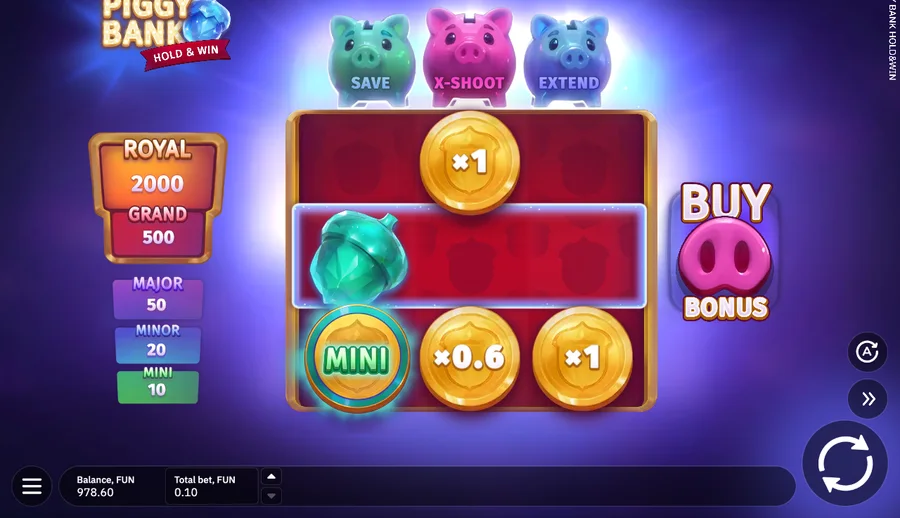
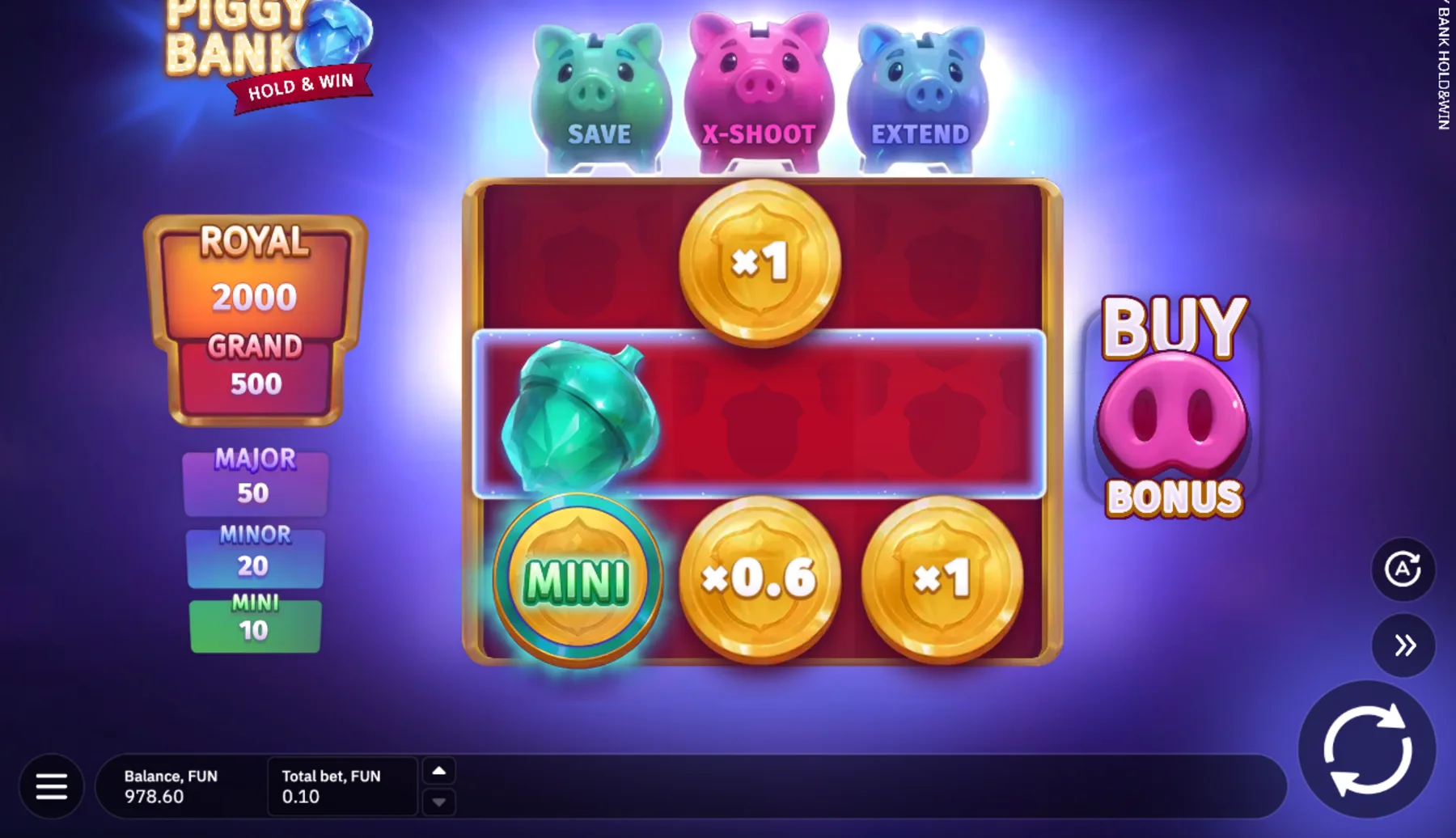
The base game never pays because every paying symbol in this game is a coin, and coins are switched off outside the round. The maker's paytable screen states the rule in one line: "All the Coins pay only in the Hold&Win Bonus game." The reels outside the round do one job. They start the round.

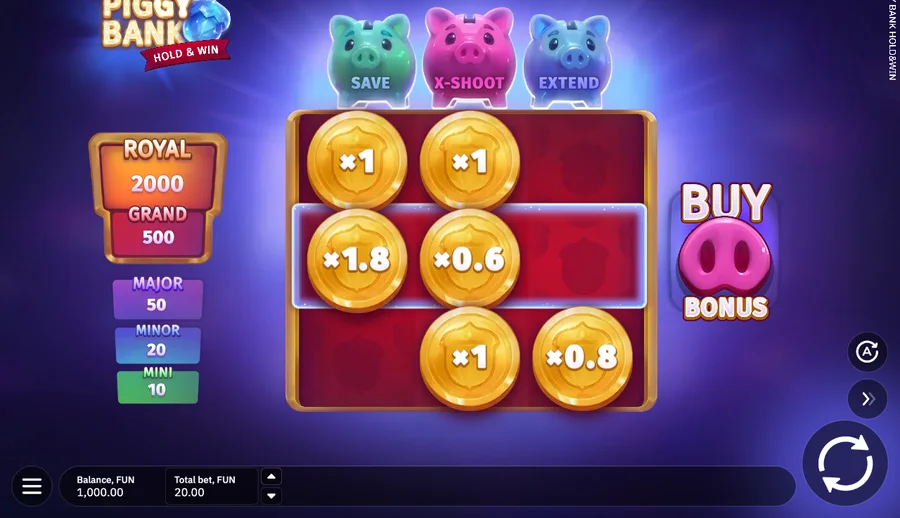
We ran 122 paid spins at a 1.00 bet in BGaming's free demo on 13 and . Every round the game server sent back went into the log. Not one of those spins paid by itself. All 100.60 that came back against 122.00 staked arrived inside the seven bonus rounds we reached.
Read that as the design rather than a cold session.
A hold and win slot splits play into two halves. The base reels decide whether you get a round. The round decides what you get paid. Three coin symbols on the central row start it here, and the rules name no other trigger. That split is why the game can sit flat for a long stretch, then hand over 31.20 in one round. Our sixth round did exactly that.
Locking, Resetting and Adding Up
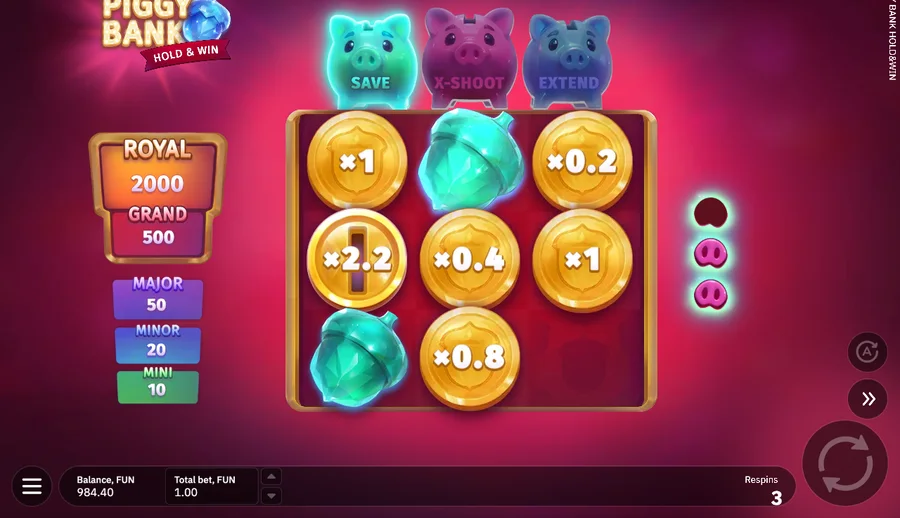
A round locks, resets and totals, in that order. Any symbol that lands holds its square to the end. The spin counter opens at 3, every new symbol resets it to 3, and an empty spin takes one away.
So the round feeds itself. It keeps going while coins keep arriving. It dies once three spins pass over an empty grid.
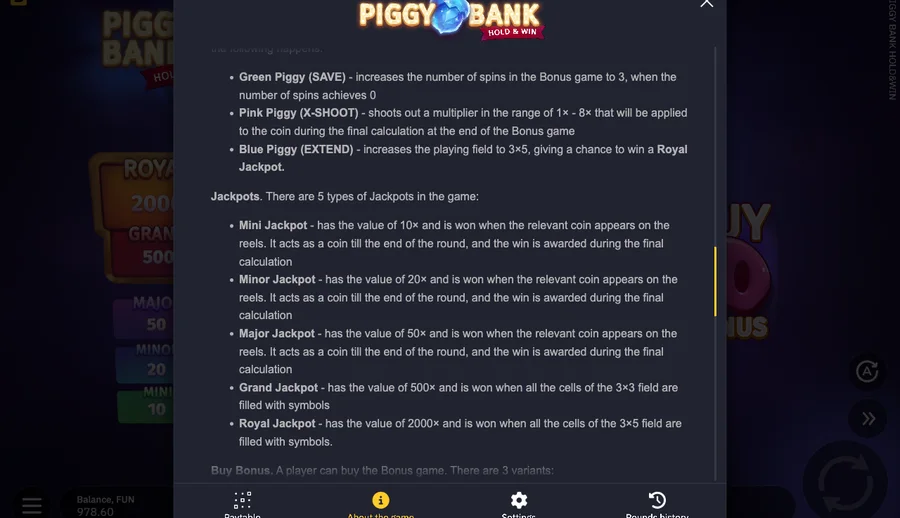
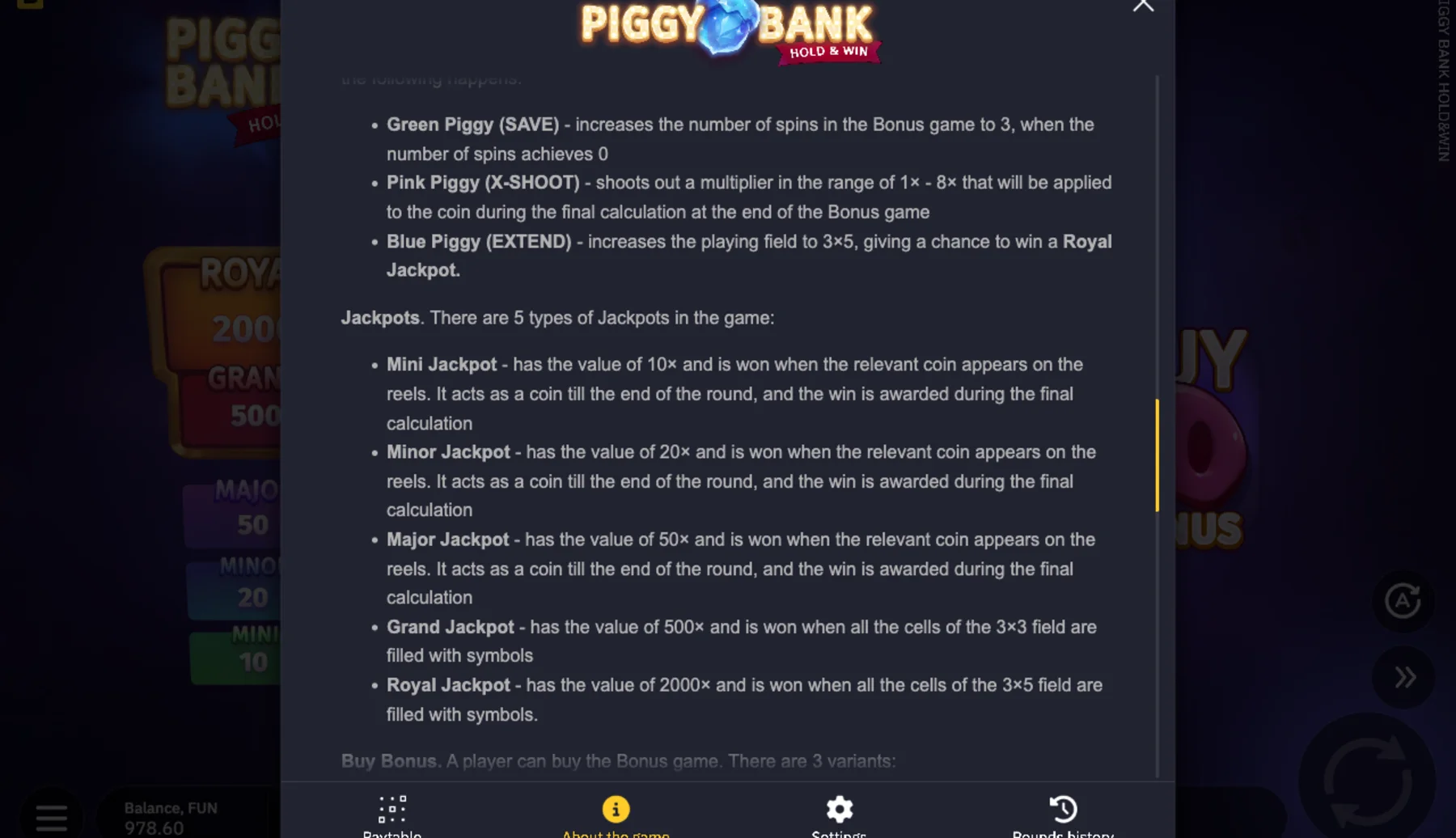
The green piggy, SAVE, is the exception. It hands back another 3 spins when the counter hits zero. It only helps on rounds where the game switched it on at the start. Pink, X-SHOOT, fires a multiplier of 1x to 8x at a coin during the final count. Blue, EXTEND, stretches the grid from 3x3 to 3x5, the only route to the Royal Jackpot at 2000x the bet.
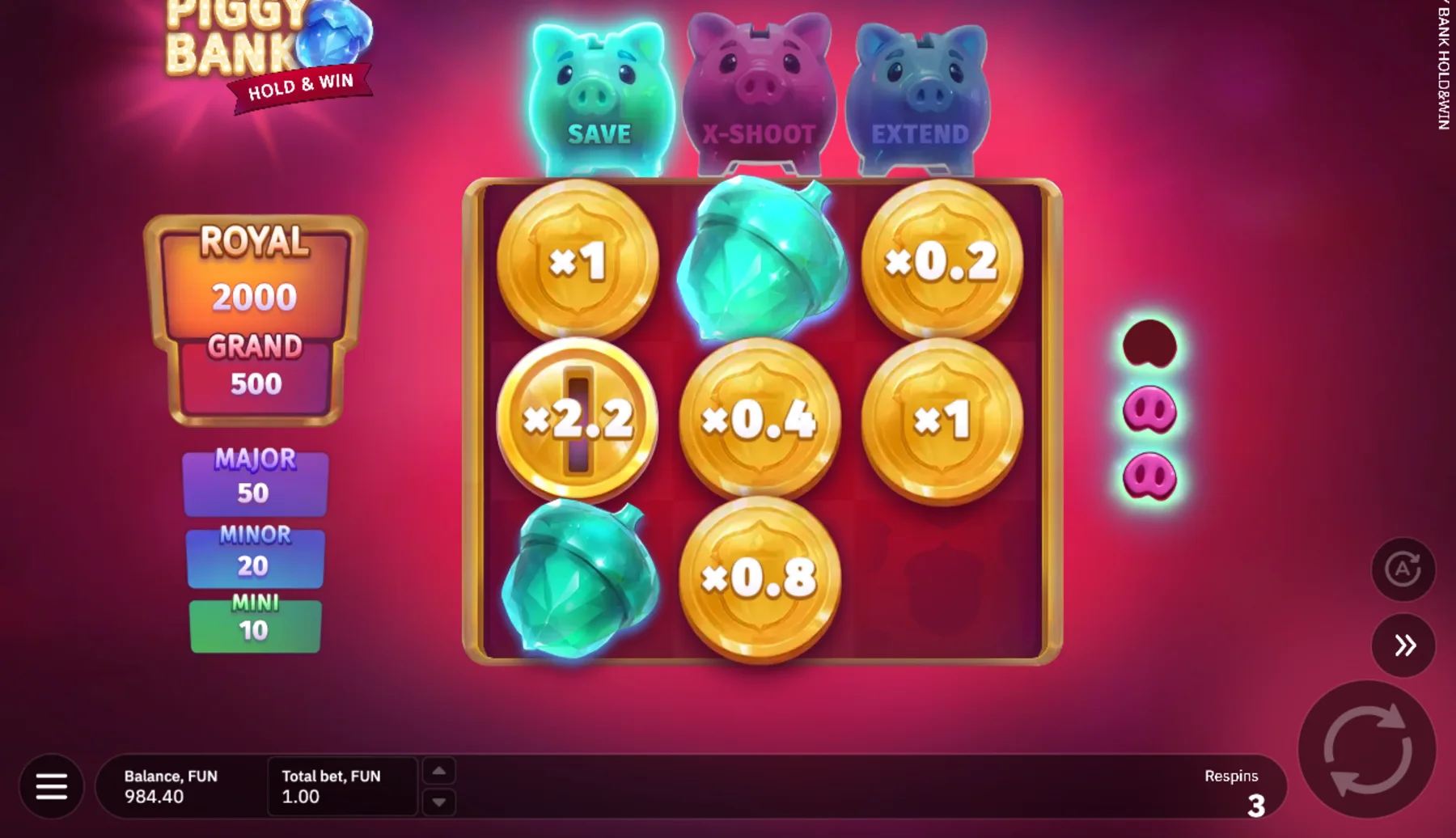
When the spins run out, the game adds up every value sitting on the grid, then pays once. The server reports those values in tenths of a bet, so a coin it calls 40 is worth 4.00 at a 1.00 stake. Here is one of our rounds, coin by coin.
| Coin on the grid | Server value | Worth at a 1.00 bet |
|---|---|---|
| First coin | 10 | 1.00 |
| Second coin | 6 | 0.60 |
| Third coin | 6 | 0.60 |
| Fourth coin | 18 | 1.80 |
| Fifth coin | 40 | 4.00 |
| Sixth coin | 8 | 0.80 |
| Seventh coin | 14 | 1.40 |
| Round total | 102 | 10.20 |
Read on ; the maker can change a screen without saying so.
The client paid 10.20, matching the arithmetic to the cent.
One other round of ours closed on 9.60, under a ribbon reading "10x Bet". That is the single round where we caught both figures, so take it as one observation rather than a rule. The cash line is the one that reached the balance.
Coins Run Smaller than Stated
Coins run smaller than the rules state, and we counted how much smaller. The rules put the Standard Coin at "the value in the range of 1x - 4x", while the game deals plenty of it below that floor. Across the 187 rounds we logged, paid spins and bonus respins together, 291 of 631 coins came in under a single bet. That is 46.1% of the coins the grid dealt.
| Coin value | Times we saw it | Share of 631 coins, to one decimal |
|---|---|---|
| 0.2x | 35 | 5.5% |
| 0.4x | 44 | 7.0% |
| 0.6x | 74 | 11.7% |
| 0.8x | 138 | 21.9% |
| 1x | 118 | 18.7% |
| 1.2x | 72 | 11.4% |
| 1.4x | 68 | 10.8% |
| 1.6x | 36 | 5.7% |
| 1.8x | 19 | 3.0% |
| 2x | 11 | 1.7% |
| 3x | 12 | 1.9% |
| 4x | 4 | 0.6% |
The column adds to 99.9% because each row is rounded on its own.
Those values showed up on screen as clearly as in the data. We watched a 0.6x coin sit beside the jackpot panel at the 0.10 minimum. Then a 0.2x coin landed inside a live round at 1.00. The rules describe a narrower range than the game deals. The gap matters. A grid filling up with 0.4x pieces looks busy while it pays almost nothing.
A full-looking grid is the cheapest thrill in this game.
What the Mechanic Costs You
The mechanic has three costs, and all three showed up in our 187 rounds.
The first is dead time. Nothing on the base reels pays, so a session is a wait punctuated by rounds, and ours waited roughly 17 paid spins between them. The second is a grid that flatters itself. Length told us little: our longest round ran 16 respins for 9.60, while our third ran three respins for 10.80. The third is the published range. The rules name a 1x floor for the Standard Coin, and 46.1% of the coins we logged sat under it.
The underlying asymmetry is straightforward enough to state precisely. This game concentrates its whole distribution inside an infrequent event, so a single spin feels almost flat while a session swings hard. Nothing intermediate survived our 187 rounds.
So the game is boring, then it is not.
We do not recommend planning a round around the top of the pink piggy's stated range. X-SHOOT is written as 1x to 8x, and across 187 logged rounds we caught it 48 times: 2x on thirty-four coins, 3x on twelve, 4x once and 7x once. Nothing above that landed at all. The low end of a stated range is the one a session actually meets.
One limit belongs on the record here.
That run of 122 measures a session rather than a game. BGaming models 96.98% for this title, and we closed 21.40 down at a session return of 82.5%. Short-run noise, not evidence about the maths. As far as the rules go, Major, Grand and Royal can all land. Across our seven rounds all three stayed away.